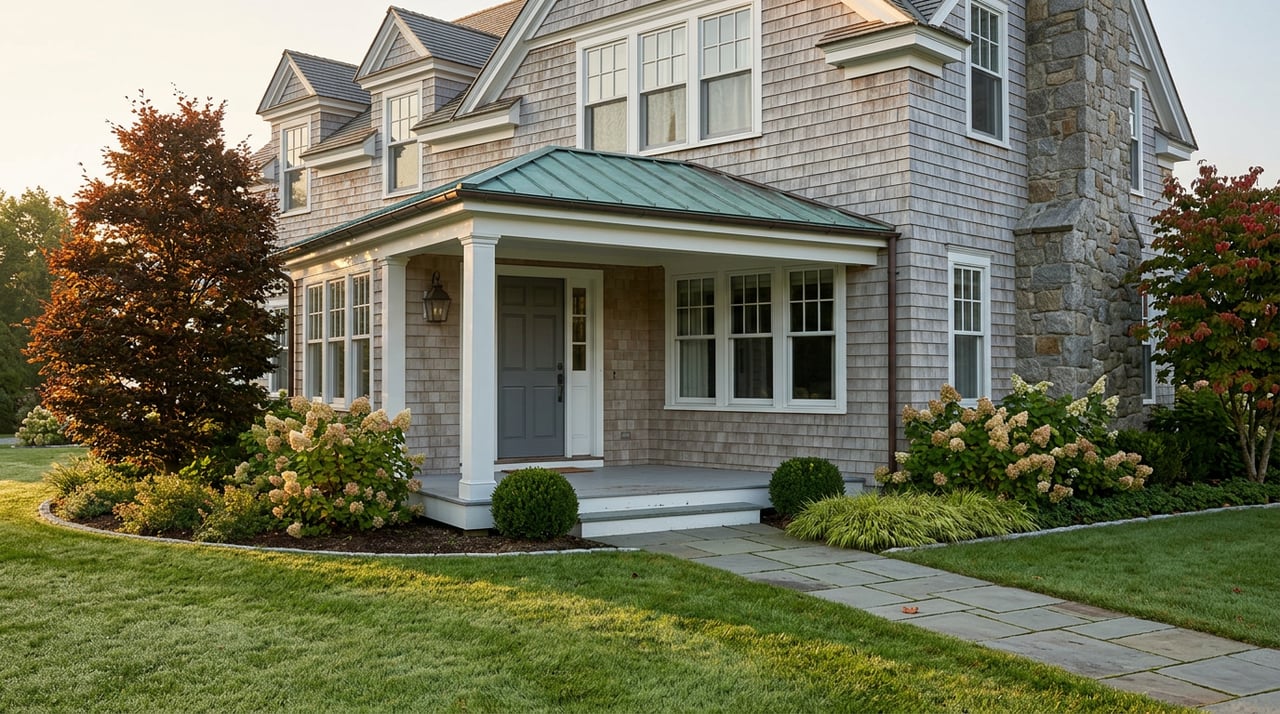
Two Colts Neck listings sit next to each other on the portal. Both show around six acres. Both are priced in the same neighborhood of the June 2026 luxury median of $2,287,000. One is a straightforward long-term hold. The other is a property whose owner will spend the next year discovering what they cannot build, cannot fence, and cannot stable. The acreage number is identical. The buildable envelope is not.
That gap is the Colts Neck market in one sentence. The portal shows you deeded land. The price is really set by what the township code lets that land do.
In an estate market where land is half the asset, the headline lot size is the least useful number on the listing sheet.
The number the portal doesn't show
The June 2026 luxury segment in Colts Neck carried 42 active listings with an average of 70 days on market, an average price per square foot of $469.80, and a median list price of $2,287,000. The broader township snapshot for May 2026 came in at a $1.79 million median with a much tighter 19-day median days on market, and price per square foot was down roughly 5 percent year over year. Read those two data points together and you get the real story: entry-level Colts Neck moves quickly, and the estate tier is where buyers are slowing down to think.
That slowdown is not softness. It is diligence. At two-million-plus, buyers are underwriting land, not just square footage, and land in Colts Neck comes with a code attached. The interesting question is not whether the market has cooled. It is why the top of the market sits on the shelf 70 days while the middle turns in 19. The answer lives in the zoning ordinance.
Where the acreage story breaks
Colts Neck's residential land is split into A-1, A-2, A-3, and A-4 districts, plus the AG Agricultural District, each with its own logic. The township's development regulations treat A-1 and A-2 as the districts meant to preserve open land, farming, wooded tracts, and view corridors. A-3 exists to accommodate the older pockets of smaller lots. The practical differences between them determine what you can add to a property after closing, and that is where value is quietly gained or lost.
A few specifics that matter more than most buyers realize:
- The 10-acre line is a use threshold, not a preference. Farm, agricultural, horticultural, and dairying uses require a 10-acre minimum. Farmettes and flag lots operate inside the same 10-acre framework. Below that, a lot generally falls under the 88,000-square-foot minimum lot area and is limited to one detached single-family dwelling with accessory uses.
- Horses are allowed in every zone, but the math tightens fast. On lots of five acres or less, the code caps horses or ponies at five total. Barns, horse shelters, and run-in sheds must be at least 100 feet from any lot line and from any dwelling on the same lot. A 4.8-acre property with a house sited near the center of the lot may not have a legal spot for a shelter at all.
- Buildable acreage is not deeded acreage. Colts Neck's code excludes wetlands, buffer areas, floodplains, conservation and open-space easements, drainage easements, and rights-of-way when calculating what counts. A ten-acre lot with three acres of wetlands buffer is not a ten-acre lot for planning purposes.
- Some uses are simply off the table. Private helistops, whether personal or commercial, are prohibited as principal, accessory, or conditional uses in every zone in the township. Facilities for keeping, training, raising, breeding, and shipping farm animals are permitted only in A-1.
- Coverage caps bite harder than they look. Recent Zoning Board of Adjustment agendas show applications like a proposed A-3 single-family dwelling seeking a variance for 9.77 percent building coverage where 6.6 percent is the maximum, and a rear-step application asking to move existing lot coverage from 22.5 percent to 22.8 percent against a 20 percent cap. These are not exotic cases. They are what happens when a family wants to add a pool cabana, a mudroom, or a rear stair on a property that was already close to its ceiling.
None of this shows up in a listing photo. All of it shows up at resale.
The preservation math next door
The other reason Colts Neck acreage behaves differently from acreage anywhere else in Monmouth County is that a meaningful share of the township is preserved. Public, quasi-public, and open-space uses account for roughly 37 percent of Colts Neck's land area, and a substantial portion of local soils are agricultural, with about 38 percent Class I and II soils and another 25 percent Class III. This is the reason your neighbor's back fence line often stops at a permanent easement rather than a future subdivision.
Recent activity keeps reinforcing that pattern. In August 2025, the Spinella family placed an 84-acre conservation easement on their Colts Neck farm through a $2.76 million partnership funded by the U.S. Navy (50 percent), Monmouth County (39 percent), Colts Neck Township's Farmland Preservation Trust Fund (10 percent), and the Monmouth Conservation Foundation (1 percent). The easement, reported by Two River Times, was structured under the Department of Defense's Readiness and Environmental Protection Integration program to buffer Naval Weapons Station Earle from future encroachment. Committee member Sue Fitzpatrick described the Navy grant as available for any property inside the military influence area. Read the resolutions list on the township site and you find the follow-through: Resolution 2024-171 supported Colts Neck's submission to the 2026 Planning Incentive Grant Program for farmland preservation.
The point for a buyer is not sentimental. Preserved neighbors set the ceiling on future development, which stabilizes long-term value and also caps certain kinds of upside. A lot that adjoins Eastmont Orchards, Delicious Orchards' 110-acre parent property on Route 34, or the Mathews barn now home to Source Brewing, is buying a permanent view. A lot that adjoins developable A-2 land is buying an option.
What to ask before you write an offer
The buyers who do best in this market slow down early. Before an offer, we work through five questions on every estate-tier property:
- What zone is the lot in, and what does the schedule of limitations actually allow at this coverage and setback? The zone code on the tax record is the start, not the answer.
- What is the buildable envelope after wetlands, buffers, floodplains, and easements are subtracted? Ask for the survey and the wetlands letter, not a rough sketch.
- If horses or a barn matter, does the geometry work? The 100-foot rule from lot lines and from the dwelling eliminates a surprising number of otherwise attractive lots.
- Is the land under a farmland preservation deed restriction? If so, the 51 percent on-farm sales rule and other agricultural covenants transfer with title. New Jersey's temporary state-of-emergency waiver of that rule this spring, reported by NJ 101.5 after the April frost, was an exception, not a permanent change.
- What is the septic and well footprint, and does it constrain a future pool, cabana, addition, or accessory dwelling? In a township where public sewer is rare outside pockets of A-3, this drives layout more than architecture does.
Answer those five, and the difference between two similar-looking listings usually becomes obvious. Sometimes the smaller lot is the better buy. Sometimes the bigger one carries hidden capacity that never made the marketing copy. Either way, the deeded acreage was never the point.
Short FAQ
Do preserved farms ever come back on the market? Yes. Preserved land can be sold, but the easement runs with the deed. A buyer inherits the restrictions on subdivision, non-agricultural use, and, for many parcels, the requirement that at least 51 percent of what is sold from the property is grown on it.
Can I get a variance for a pool cabana or a larger accessory structure? The Colts Neck Zoning Board of Adjustment hears these applications regularly. Approvals happen, but they are not automatic, and the variance record travels with the property. A buyer counting on a future variance should treat it as a possibility, not a plan.
Does inland Colts Neck track the Jersey Shore market? Only loosely. The estate segment here is driven by land supply, preservation activity, and the Route 34 corridor rather than beach demand, which is why days on market and price behavior can diverge sharply from Spring Lake or Point Pleasant in any given quarter.
If you are weighing a Colts Neck property and want a second read on the zoning, the buildable envelope, and what the acreage will and will not support, Michele Taylor works these questions in advance of every offer. Reach out for a private conversation before you fall in love with a lot line.