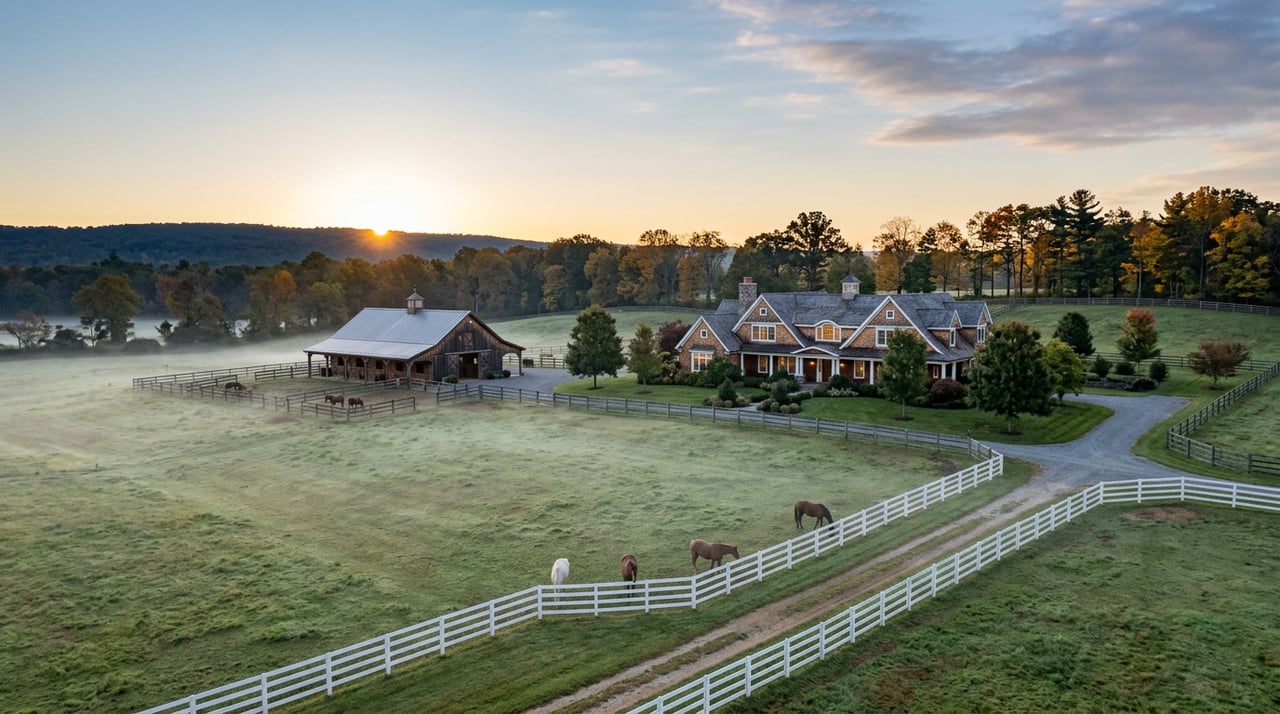
A buyer under contract on a horse property in Colts Neck recently sent her attorney a one-line question: why is the property tax bill on a twelve-acre parcel with a six-stall barn lower than the bill on her current half-acre lot in Ocean Township. The listing sheet showed a number that looked almost affordable for the acreage. Her attorney's answer took longer than the question. That low number wasn't a mistake. It was a Farmland Assessment, and it belongs to the land's current use, not to her.
This is the piece of due diligence that doesn't show up in a home inspection, doesn't appear on most buyer checklists, and can cost a new owner six figures if it's discovered after closing instead of before signing.
The number on the listing isn't guaranteed to follow you
New Jersey's Farmland Assessment Act lets qualifying agricultural land get taxed on its farming productivity instead of its market value. In a township like Colts Neck, where large-lot equestrian and agricultural properties are common, that difference is substantial. Land that would otherwise carry a market-rate tax bill can see that portion of its assessment cut by roughly 80 to 95 percent, according to the New Jersey Division of Taxation.
To qualify, a property needs at least five contiguous acres actively devoted to agricultural or horticultural use, generating a minimum level of income from that use, for at least two years before the tax year in question. The owner has to file Form FA-1 with the municipal tax assessor every year, by August 1 of the year before the tax year it covers. Miss that filing, or stop farming the land, and the discount doesn't pause. It ends, and the township looks backward.
Here's the part that catches buyers off guard: the Farmland Assessment attaches to the land's use, not to a specific owner. If a seller has kept the FA-1 current for years, the low tax bill on the listing sheet reflects that use continuing. If the buyer's plans don't include boarding horses, growing hay, or otherwise maintaining a qualifying agricultural operation, that status can lapse the moment the deed changes hands and the use changes with it.
What happens when the discount disappears
New Jersey law doesn't just raise the tax bill going forward when farmland status lapses. It applies a rollback tax that recaptures the difference between what was paid under Farmland Assessment and what would have been paid at full market value, for the current year plus the two prior years, with interest.
The mechanics work like this, using the kind of example the state's own guidance describes: a twenty-acre parcel that would normally carry a $25,000 annual tax bill drops to roughly $1,500 a year under Farmland Assessment. If that status lapses, the owner owes the difference for three tax years, a bill that can exceed $70,000 on a twenty-acre parcel alone.
Colts Neck's premium equestrian estates run well past twenty acres. Scale that same gap across a hundred-acre property carrying Farmland Assessment on most of its land, and the rollback exposure runs into six figures. It's not a hypothetical. It's built into the statute, and it's designed specifically to prevent land from sitting under a farm tax rate while functioning as something else.
The rollback bill lands on whoever owns the property when the disqualifying event happens. If that's the new buyer, closing didn't make the exposure someone else's problem. It made it theirs.
Why this matters more in Colts Neck right now than it did a few years ago
Colts Neck's own tax picture makes this a live issue in 2026, not a dormant one. The township's certified general tax rate for 2025 is $1.394 per $100 of assessed value, a figure that sits mid-pack for Monmouth County. But the average residential tax bill, based on the state's 2024 assessment data, comes in at roughly $16,668, the fifth-highest of the county's 53 municipalities. That gap between a moderate rate and a high bill is a function of Colts Neck's large lots and estate-scale construction, not an unusually aggressive tax rate.
The township has also been running its assessments close to full market value under its ongoing reassessment cycle, rather than letting assessed values drift behind actual sale prices the way many older-assessment towns do. That matters here because the rollback tax is calculated against full market value. As assessments in Colts Neck track closer to what properties actually sell for, the gap between a farm-assessed tax bill and a full-market tax bill widens, which means the same twenty-acre example above produces a larger dollar swing today than it would have when assessments lagged further behind the market.
Two more systems you're buying along with the land
Farmland status isn't the only closing-specific detail unique to how Colts Neck properties are actually built and used. Most homes here rely on private wells and septic systems rather than municipal water and sewer, which means two additional pieces of due diligence run in parallel with the farmland question.
New Jersey's Private Well Testing Act requires that a certified laboratory test the well water on any property being sold with a private well, with results completed and shared at least 30 days before closing. If a seller doesn't complete that testing, the responsibility shifts to the buyer, but the seller still carries disclosure risk if a known issue wasn't shared.
Separately, Colts Neck's own Health Department has to sign off on septic and well locations before it approves permits for pools, barns, decks, sheds, cabanas, fences, or retaining walls. That approval requires a Health Water Well & Septic System Form verifying exactly where those components sit on a current survey. On a large parcel, this isn't paperwork for its own sake. It determines where future improvements can legally go, which matters enormously if part of the appeal of buying acreage is the room to add a barn, a pool, or a second structure down the line.
Before signing on a Colts Neck estate or equestrian property, a buyer's due-diligence list should include:
- Confirming with the Township assessor whether Farmland Assessment status is currently active and whether the seller's FA-1 filings are up to date
- Asking what the property's tax bill would look like at full market assessment, not just what the current farm-assessed bill shows
- Verifying septic and well locations against a current survey before assuming where a pool, barn, or addition could go
- Scheduling the Private Well Testing Act water test early enough that a 30-day result window doesn't collide with a tight closing date
- Discussing with an attorney whether the purchase agreement should address rollback exposure directly, rather than leaving it to surface after closing
The scale of what's at stake here isn't abstract. Colts Neck's market has produced headline listings like WellSpring Stables, a 160-acre thoroughbred breeding operation that came to market at $27.9 million, the kind of estate where farmland-assessed acreage is doing real work in the tax picture. On the other end of the spectrum, longtime owners like the Springsteen family have kept their roughly 400-acre horse farm in active agricultural use for decades, which is exactly the kind of continuity that keeps a Farmland Assessment intact. A buyer stepping into a smaller version of that same setup, without the same intention to keep it running as a working farm, is the profile most exposed to a rollback surprise.
A short FAQ
Does every large-lot property in Colts Neck carry Farmland Assessment? No. It only applies to parcels that meet the acreage, use, and income requirements and where the owner has filed Form FA-1 annually. Some large properties pay full market-rate taxes because they don't qualify or the owner chose not to pursue it.
Can I keep the Farmland Assessment without keeping horses? Possibly, if the land supports another qualifying agricultural or horticultural use that meets the income threshold. Continuing horse boarding or breeding is one path, but it isn't the only one. This is worth confirming with the township assessor before assuming either way.
What if the rollback triggers after I've already closed? The tax follows the property regardless of when the disqualifying event is discovered, so it can still land on the current owner even if the change of use happened gradually after closing. This is exactly why verifying status and discussing contract protections before signing matters more than trying to resolve it afterward.
Buying land in Colts Neck means buying more than square footage and a house. It means buying into a tax structure, a septic and well system, and in many cases a farming designation that only stays in place if the next owner keeps it running. Michele Taylor works with buyers across Monmouth County who want that full picture before they write an offer, not after they've closed. If you're evaluating a Colts Neck property and want help thinking through what the listing's tax line actually means for your plans, reach out to Michele Taylor Properties to talk it through.