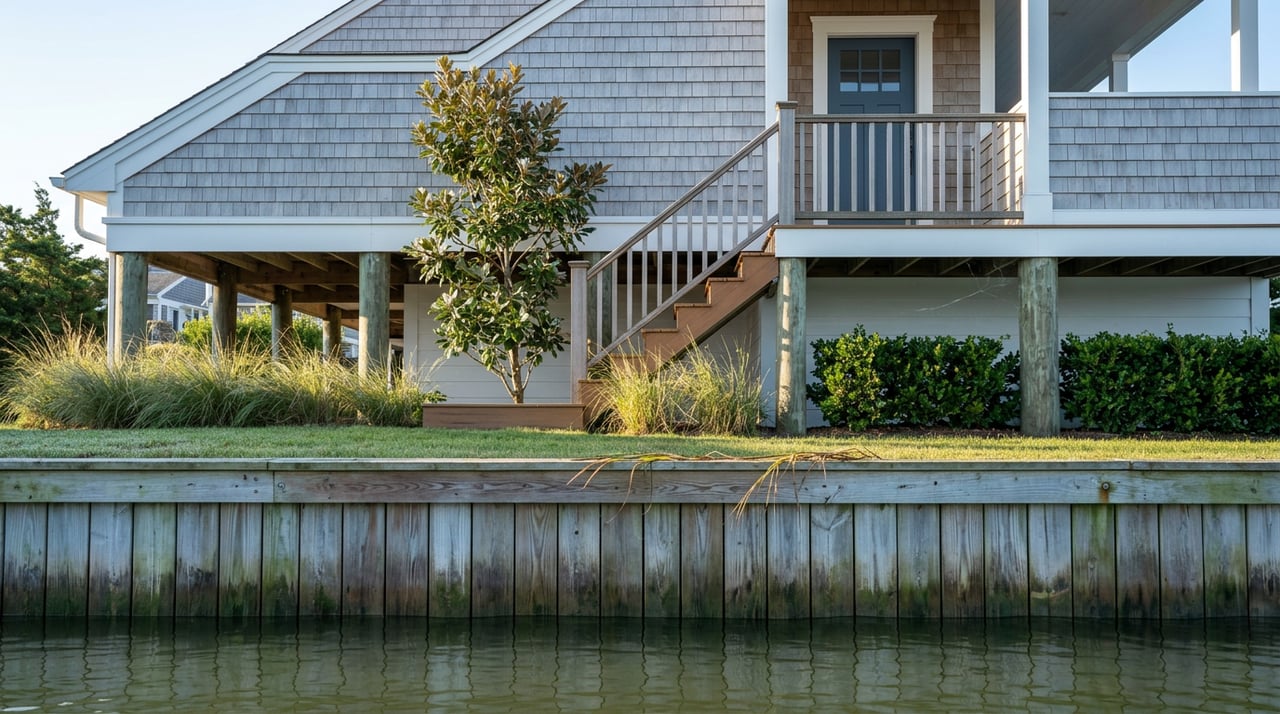
Two homes on the same lagoon block in Point Pleasant Borough can carry the same asking price and mean two completely different financial commitments. One sits on a bulkhead poured in the 1970s, its foundation set to a flood elevation nobody would specify today. The other was rebuilt in the last decade, elevated well above the old FEMA baseline, bulkhead replaced with steel sheet piling under a permit that already accounted for storm risk. The listing sheet shows the same square footage, the same bedroom count, maybe the same dock length. It does not show which flood-elevation standard governs what happens if that bulkhead fails and needs to come out.
That distinction just got more complicated, and more time-sensitive, than most buyers realize.
Why water access is the whole story here
Point Pleasant Borough is not Point Pleasant Beach. The Borough sits inland along the Manasquan River, a separate municipality with its own government and school district, built around a network of lagoons and canals rather than an oceanfront boardwalk. That network exists because of a specific piece of infrastructure: the Point Pleasant Canal, a roughly 150-foot-wide, 1.7-mile waterway connecting the Manasquan River to Barnegat Bay, constructed in 1925. That cut of earth is why interior homes in the Borough sit in the $700,000s while lagoon-backed properties with private dock access run into the low seven figures and beyond as of early 2026. Square footage does not set that gap. Deep-water access does.
Anyone shopping this market already knows lagoon frontage costs more. What most buyers underestimate is that the frontage itself comes with a maintenance obligation that standard interior homes never face, and that obligation is currently governed by a rule that has already changed twice this year.
What a bulkhead actually costs, and who is on the hook
A bulkhead is a vertical retaining wall, typically steel, timber, or vinyl sheet piling, that holds the shoreline in place against tidal action and wave energy. Every lagoon lot in the Borough has one, and every bulkhead has a service life. When it fails, replacement runs $30,000 to $80,000 or more depending on linear footage, and lenders financing waterfront purchases frequently require a structural assessment of the bulkhead before they will close. That is not a cost that shows up in the comparable sales a listing agent pulls. It shows up in the inspection period, or worse, after closing when the seawall the buyer assumed was sound turns out to be original to the house.
The Army Corps of Engineers' own bulkhead work on the Point Pleasant Canal gives a sense of scale. A recent Corps project on the canal itself involved demolishing roughly 60 linear feet of existing bulkhead, excavating behind the wall, and installing new steel sheet piling in front of a concrete abutment, along with a drainage system behind the new wall. That is the kind of work a homeowner on a private lagoon lot pays for out of pocket, at residential scale, without a federal budget behind it.
The rule that moved twice in one year
Bulkhead reconstruction in New Jersey's coastal zone requires a permit, and as of this year, the permitting standard itself is in motion. On January 20, 2026, the New Jersey Department of Environmental Protection adopted its Resilient Environments and Landscapes rule, known as REAL. The rule requires new construction and substantial improvements in tidal flood areas to be built four feet above FEMA's base flood elevation, a significant jump from the one to two feet of freeboard previously typical. It also introduced a 180-day legacy window, meaning any project with a technically complete application filed by July 20, 2026 could still be reviewed under the old, less demanding standard.
That deadline never actually arrived in the form most 2026 real estate coverage assumed it would. On June 1, 2026, weeks before the original cutoff, Governor Sherrill and NJDEP Commissioner Ed Potosnak announced a one-year extension of the legacy period, pushing the deadline from July 20, 2026 to July 20, 2027. The core requirements of REAL, the four-foot elevation standard, the new Inundation Risk Zone designation, the climate-adjusted flood elevation calculation, remain adopted law. Only the enforcement timeline shifted, giving the state room for a stakeholder review after more than 130 New Jersey mayors and both the state's builders' and business associations had pushed back on the original schedule.
Here is what that extension actually does for a Point Pleasant lagoon buyer:
| Original REAL Timeline | Current Timeline (as of Sept. 2026) | |
|---|---|---|
| Rule adoption | January 20, 2026 | January 20, 2026 |
| Legacy window closes | July 20, 2026 | July 20, 2027 |
| Elevation standard once legacy window closes | +4 ft above FEMA BFE | +4 ft above FEMA BFE |
| Applications filed before deadline | Reviewed under prior standard | Reviewed under prior standard |
The elevation requirement itself has not softened. What changed is how much time a property owner has to get a technically complete application in front of NJDEP before that requirement becomes mandatory.
What the extra year is actually worth
For a buyer eyeing an older, non-elevated lagoon home in Point Pleasant with plans to rebuild or substantially renovate, this extension is not academic. A project that gets a complete application filed before July 20, 2027 can still be permitted under the older flood-elevation standard, which typically means a lower foundation height, a shorter pile system, and a less expensive build than one designed to meet the new four-foot standard. Miss that window, and the same renovation gets reviewed under REAL, with all the added elevation, engineering, and stormwater compliance costs that come with it.
This cuts two ways for anyone actually shopping the lagoon market right now. A dated, un-elevated bulkhead-front property that looked like a difficult renovation candidate six months ago now has an extra year of runway to permit under the older rules, which can make the numbers on a teardown or gut renovation pencil out differently than they did in the spring. At the same time, that runway has a hard stop. A buyer who assumes they have unlimited time to plan a rebuild is working against a real deadline that the state has already moved once and may not move again.
None of this is a reason to avoid lagoon property in the Borough. The waterfront premium exists because deep-water access to the Manasquan River, and from there to the Atlantic through the Manasquan Inlet, is not something an interior lot can ever replicate. It is a reason to ask different questions before writing an offer.
Before you write an offer on a lagoon lot
- Ask for the age and material of the existing bulkhead, and whether any reconstruction has been permitted or performed in the last decade.
- Request the current flood zone designation and, if available, an elevation certificate. This is the single document that determines both insurance pricing and how much room exists under the current standard.
- If a renovation or rebuild is part of the plan, ask whether the seller or a prior owner has ever filed with NJDEP for this property, and whether that filing predates the January 2026 rule change.
- Confirm with a lender early whether a structural waterfront assessment will be required before closing, since this can add time to the mortgage contingency period.
- If the property may need bulkhead work within the next few years, get a contractor estimate for linear footage before finalizing an offer price, not after.
A short FAQ
Does the REAL rule apply to a bulkhead I am just replacing, not rebuilding my whole house? Bulkhead reconstruction is regulated under New Jersey's Coastal Zone Management rules, which REAL amended. Whether a specific bulkhead repair triggers the new elevation standard depends on the scope of work and whether it is paired with other construction on the property. This is a question for a coastal permitting professional, not a general assumption either way.
If I buy a home now, am I required to elevate it? Existing homeowners are not required to elevate a home simply because REAL exists. The standard applies to new construction and to projects that qualify as a substantial improvement, generally renovation work that exceeds a set percentage of the home's value.
Is the July 2027 date final? The extension was proposed and confirmed through June 2026 sources, with NJDEP expected to take final action after a stakeholder review process later in the year. Anyone planning a project timed to this deadline should confirm the current status directly with NJDEP before finalizing renovation plans.
A lagoon address in Point Pleasant Borough is genuine infrastructure, not just a view. Buying one well means pricing the water honestly, understanding what stands between the house and the canal, and knowing exactly which set of rules governs it on the day you close. Michele Taylor works with buyers and sellers across the Jersey Shore who want that clarity before they write an offer, not after.