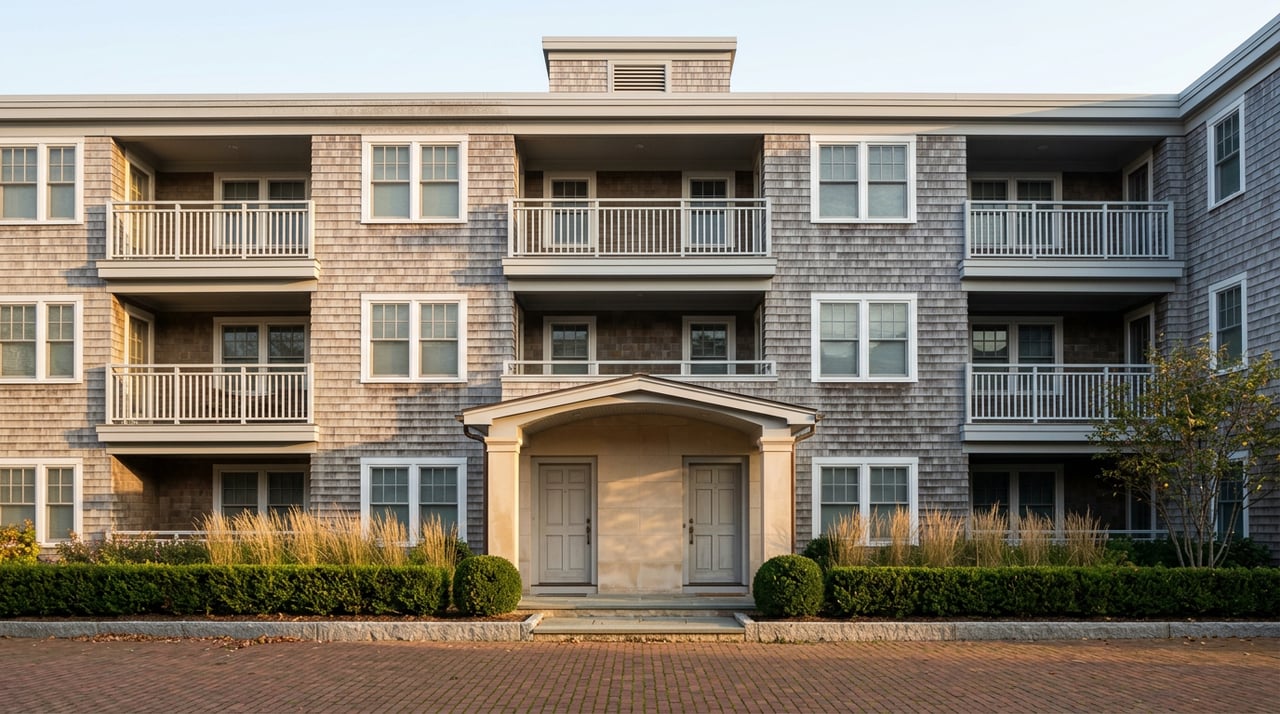
Picture the attorney review call. You've found the unit. Corner exposure, a terrace, the right building. Your attorney reads through the condo docs and stops on a page with a paragraph set in bold type large enough to read from across the room. It says the association has elected to fund its capital reserves at 85 percent of what its own reserve study recommends, and it names a year when a special assessment or loan is expected, along with the dollar figure.
That paragraph exists because New Jersey law now requires it. And it is the single best argument for why the price per square foot on an Asbury Park condo listing tells you almost nothing about what the unit will actually cost you to own.
Two buildings, same numbers, different math
Asbury Park's condo market has produced some of the most dramatic appreciation on the Jersey Shore. Units at Vive sold for roughly $228 per square foot in 2013. By 2016 that had climbed to $364. Recent closed sales in 2025 and 2026 put the same building at $751 per square foot, a 230 percent run in price per square foot over about twelve years. South Grand, the K. Hovnanian townhome community that brought a national builder back into Asbury Park for the first time since 1984, has been trading between $500 and $600 per square foot with HOA dues running around $450 a month.
Those are real numbers. What they don't tell you is what happens to your monthly and annual costs after closing, because two of the biggest variables in Asbury Park condo ownership never show up in a per-square-foot calculation: how much runway is left on the building's PILOT agreement, and whether the association's reserve fund is actually keeping pace with the building's age.
The PILOT is doing more work than the tax line suggests
Most of Asbury Park's major condo developments, including LIDO, Asbury Ocean Club, Wesley Grove, South Grand, and Vive, were built under long-term PILOT agreements. PILOT stands for Payment in Lieu of Taxes, a mechanism authorized under New Jersey's Long-Term Tax Exemption Law. Instead of paying conventional property taxes assessed on the improved value of the building, owners in a PILOT community pay an annual service charge to the municipality, one that's structured to run lower than what full taxation would produce. Wesley Grove's PILOT, dating to the early 2000s, currently shields a municipal assessed value of $78.3 million from conventional taxation. Some individual units carry annual PILOT charges in the range of $10,000 to $12,000, with 20 or more years remaining on the agreement, according to recent listing disclosures.
The part that gets skipped in casual conversation is what happens when the agreement runs out. PILOT terms are finite. When one expires, the building rolls onto the conventional tax roll, and the owner's annual carrying cost resets to whatever a fully assessed property in that location and value range would owe. A unit bought today with 22 years left on its PILOT is a very different long-term hold than an identical unit in a building whose PILOT expires in six.
This is the first reason two units at the same price per square foot are not the same purchase. One is buying you two decades of suppressed taxes. The other might be buying you six years and then a jump.
The reserve law changed what a seller has to hand you
The second variable is newer and less understood, even by people who've bought condos here before. In January 2024, New Jersey enacted a law requiring condominium and cooperative associations to conduct a capital reserve study and fund their reserves on a defined schedule. The law amended the Planned Real Estate Development Full Disclosure Act, the statute that governs common interest communities in the state, and it applies to any association responsible for maintaining shared structural components like roofs, exteriors, and mechanical systems, provided the community has at least $25,000 in common area capital assets.
In August 2025, the legislature amended that law again. The update, known as S3992, redefined what counts as adequate funding: a 30-year plan in which the reserve balance never falls below zero. It also created a temporary option letting boards fund at 85 percent of the recommended level for up to five years, provided they disclose it clearly. That disclosure is the bold-type paragraph from the opening of this piece. If a board elects the 85 percent option, it must notify every owner in 20-point bold font, and if a special assessment or loan is anticipated as a result, the notice has to name the year and the amount. Anyone selling a unit during that funding period has to hand a copy of that notice to their buyer before the contract is signed.
Buildings with a certificate of occupancy issued before January 8, 2009 were also required to complete their first structural inspection under the law by January 8, 2026, if their primary load bearing system is concrete, masonry, steel, or a hybrid structure. That deadline has now passed, which means any Asbury Park building in that category should already have a completed inspection report on file. A listing agent or association that can't produce one for a building of that age is worth a direct question before you go further.
Why this matters more in Asbury Park than most towns
Asbury Park's condo market has an unusual mix of building ages sitting side by side. North Beach and Wesley Grove date to the mid-2000s. Vive and South Grand followed in the early 2010s. LIDO and Asbury Ocean Club represent the newest, most heavily amenitized tier. A reserve study and a structural inspection mean something different for a 20-year-old building with an aging roof and elevator system than for a building that opened five years ago. The same law applies to all of them, but the practical exposure is not evenly distributed.
Put the two mechanisms together and you get the real comparison a buyer should be making, one that has nothing to do with square footage:
| What to check | Why it changes your cost |
|---|---|
| Years remaining on the PILOT | Determines when your tax line resets to full assessment |
| Reserve funding level (baseline vs. 85 percent) | Signals whether a special assessment is already anticipated |
| Building's certificate of occupancy date | Tells you whether a structural inspection deadline applies |
| Most recent reserve study date | A study older than five years is likely out of compliance |
Two units at $751 per square foot in different buildings can carry entirely different five-year cost trajectories once you account for these four lines. A buyer comparing listings on price alone is comparing the wrong thing.
What to actually ask for before you write an offer
Before submitting an offer on any Asbury Park condo, ask the listing agent or the association's management company for three documents: the most recent capital reserve study, the PILOT agreement or a summary of years remaining, and any board notice related to the 85 percent funding option. If the seller can't produce a reserve study less than five years old, that alone is worth flagging to your attorney, since it likely means the association isn't yet in compliance with the 2024 law.
None of this shows up on a listing sheet. It shows up in a folder of condo documents that most buyers don't ask for until the attorney review period is already underway, which is often too late to negotiate around it.
A short FAQ
Does every Asbury Park condo building have a PILOT agreement? No. PILOT agreements are negotiated individually between a developer and the city, and not every building has one. Older, smaller communities and some resale-only buildings were never part of a PILOT deal, so it's worth confirming rather than assuming.
Is the reserve study law the same as a home inspection? No. A home inspection covers your individual unit. The reserve study covers the building's shared systems, roofs, elevators, structural components, and it's the association's obligation, not the unit owner's. You should still get your own unit inspected separately.
What happens if a building fails its reserve funding requirement entirely? The Department of Community Affairs doesn't have jurisdiction over a board's spending decisions or assessment votes. Disputes get resolved through the association's governing documents or, if necessary, through the courts. That's one more reason to see the paperwork before you're under contract, not after.
If you're comparing specific Asbury Park buildings and want someone who reads the PILOT terms and the reserve study before you fall for the terrace, Michele Taylor can walk the documents with you before you write the offer, not after.